
Starting from a thesis and a crisis, Georg Molzer built Shadowmap into the definitive tool for understanding sunlight. Here's how Location APIs and vector map tiles from Stadia Maps help.
Summary
Shadowmap is a Vienna-based company that uses Stadia Maps for map tiles. Founded by Georg Molzer, Shadowmap lets users simulate the sun's position and shadow patterns anywhere on Earth, in real time and in 3D. It also powers sunlight-scoring features for major real estate platforms, including Redfin and Willhaben. Shadowmap serves 700,000+ monthly active users across use cases that include home buying, solar energy planning, architecture, urban planning, and photography.
Highlights
- More than 700,000 monthly active users globally
- Key integrations, including Redfin, the third-largest U.S. real estate platform, powering sunlight scores across its listings, and Willhaben, Austria's largest real estate platform
- Offers the Sunscore API, what Shadowmap refers to as the first building-level sun exposure rating system (0-100) of its kind, and 3D Solar Analytics, which calculates solar potential in real time for rooftops and vertical surfaces
- Driven by Redfin integration and Sunscore API adoption, Shadowmap doubled its full-year 2025 Stadia Maps API usage in just the first half of 2026
It started with a window.
In the winter of 2010, Georg Molzer was sitting in his dark apartment in Vienna. Two weeks had passed without seeing the sun. He wanted one simple thing: a tool that could tell him, at noon, exactly where on the street he could find a bench in the sunlight to spend half an hour.
That tool didn't exist. So Georg decided to build it.
More than a decade later, Shadowmap now has more than 700,000 monthly active users, a partnership with Redfin that powers sunlight scores for millions of U.S. home listings, and a profitable business built on an original insight: where sunlight falls is knowable, but until Shadowmap, almost nobody had the tools to see it.
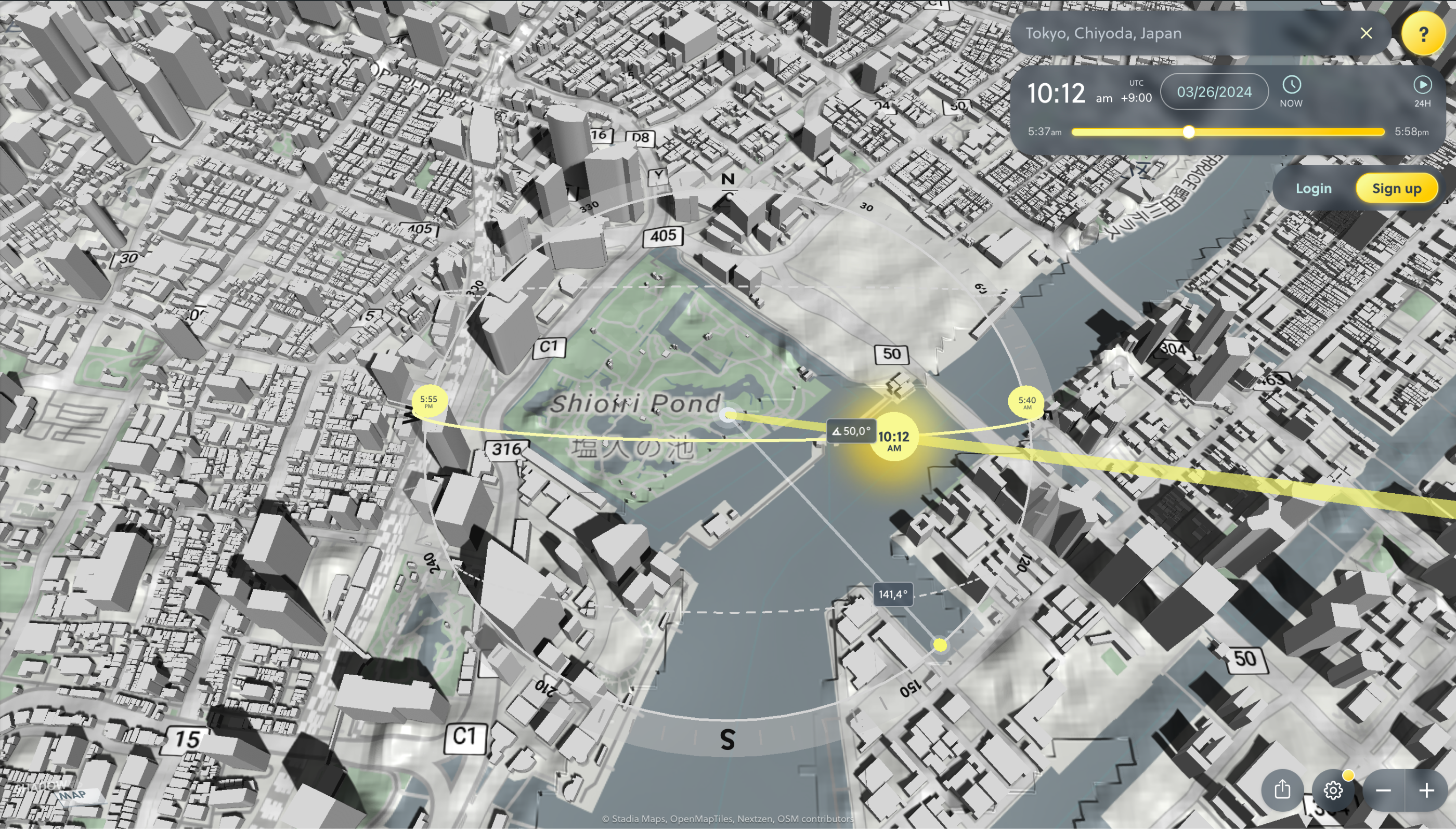
Shadowmap displaying over our Alidade Smooth map style.
Building Something That Didn't Exist
Georg studied computer science at the Vienna University of Technology, specializing in visual computing. "I've always been passionate about programming and making data more understandable for humans," he says. "Technology should really work for humans. Not the other way around."
When he finally started building in earnest in 2018, Georg made a deliberate choice to write his master's thesis on Shadowmap, not just as a forcing function, but as a kind of public declaration. Most theses get shelved the moment the degree is awarded. Georg was betting his wouldn't, because he built in a reason it couldn't. "I always knew that if I didn't work on something that ends up being used by people, I wouldn't really finish it."
The Shadowmap beta launched on Product Hunt in summer 2021. People liked it immediately. An investor followed shortly after.
A Tool for Every Use Case Involving the Sun
Shadowmap's user base is intentionally broad and includes consumers and businesses.
Consumer use cases range from people evaluating how much sunlight a home gets in December to photographers scouting locations to gardeners planning beds. "We built an interface to the sun," Georg says. "You can simulate the sun's position and the shadows it casts based on 3D data, for any location on Earth, at any time or time period."
On the B2B side, Shadowmap works with solar installers who calculate energy potential and with architects who analyze shadows at scale. The company has partnerships with Willhaben, Austria's largest real estate platform, and Redfin, the third-largest U.S. real estate platform. Redfin integrated Shadowmap's full suite, including interactive 3D sunlight simulation, solar analytics, photorealistic Google 3D Buildings, and the Sunscore API, which rates any building's sun exposure from 0 to 100. "Nobody else has done this yet," Georg says. "It's a cool way to not only visualize, but to get a single metric. You can ask the system: show me the five brightest homes in San Francisco."
Building a 3D Sunlight Engine with Three.js
When Georg started building, existing 3D map engines fell short. Cesium, MapLibre, and Mapbox all missed on at least one dimension: mobile performance, shadow rendering quality, or rendering range.
"I was really stubborn," he says. "I'm navigating in a 3D world with 3D structures casting shadows. Of course, it needs to be 3D."
He evaluated the available engines and chose Three.js and TypeScript. A web-first architecture means the same rendering engine runs in browsers and inside native apps on iOS and Android.
One thing Georg is clear about for other developers building in this space: don't shortcut the rendering pipeline. "Some competitors only let buildings receive shadows from other buildings. They don't receive shadows cast by mountains because the pipeline wasn't designed for it from the ground up. Ask yourself honestly: do you really want to solve the problem, or just part of it?"
Why Shadowmap Chose Stadia Maps
Like many early-stage decisions, the move to Stadia Maps began with a crisis. Georg had been using a small Austrian maps provider that offered data at no cost. "I decided to part ways, and then I was just looking for an alternative."
A Google search surfaced Stadia Maps. He'd never heard of the company before. "It sounded almost too good to be true: really affordable pricing, and the map style fit. Not crazy colorful, which I liked."
For a team running a custom Three.js renderer on mobile, tile performance and reliability weren't optional. He reached out. The Stadia Maps team offered pricing that made it feel possible to continue building. "It was, honestly, a sigh of relief," he recalls.
What's kept the relationship strong goes beyond just pricing: it's how Stadia Maps actually behaves as a partner to Shadowmap. "Response times are legendary. Always super quick, always super friendly, always solution-oriented." When Shadowmap's designer developed a custom color scheme that didn't match any existing tile style, Stadia Maps worked to create a bespoke map style, which is now offered to all Stadia Maps customers.
Shadowmap and Stadia Maps are growing together. Shadowmap's API usage doubled in the first six months of 2026, surpassing what it used in all of 2025.
For a developer evaluating location API providers, Georg is direct: "The Stadia Maps team is competent, their APIs are affordable, and there's no bullshit. The dashboard has anything you want, and it's clear what you're going to pay."
A Mission Behind the Product
Ask Georg what drives Shadowmap, and he'll talk about health before product-market fit.
Sunlight, he argues, is important for human health in ways most people underestimate. Shadowmap runs a podcast called Sunlight Matters and connects with scientists, doctors, and astronomers working on the frontier of that research. "We want to nudge the whole industry in a better direction, where architects and developers plan in a way that makes a healthier, happier, more creative choice for humans."
The profitable company now has nine employees, spread across Vienna, the UK, Amsterdam, and Florida.
"Sunlight is crucial for your cells," Georg says. "If you're going to buy an apartment, you should know how it's lit in December, not just June. That's all we're trying to help with."
Frequently Asked Questions
What is Shadowmap?
Shadowmap strives to provide a platform that connects humanity with the natural benefits of the Sun, enabling people to better understand, utilize, and plan with the Sun as a source of life, energy, and light.
What is Stadia Maps?
Stadia Maps provides APIs for maps, geocoding, search, routing, and navigation for developers building location-based applications. The platform is privacy-first: no tracking, no telemetry requirements, and GDPR/CCPA compliant by default. Pricing is credit-based, usage-driven, with no hidden multipliers for active users. Shadowmap has run on Stadia Maps since 2021.
How does Stadia Maps compare to Google Maps API and Mapbox?
While other providers charge unpredictable map load fees or require mandatory telemetry, Stadia Maps offers simple request-based billing with no hidden multipliers and is GDPR/CCPA compliant by default with no tracking or telemetry requirements. Stadia Maps is built on open formats, including Mapbox Vector Tiles and the OpenMapTiles schema, so you can use open-source renderers like MapLibre and Leaflet without lock-in. Support is developer-to-developer: you talk directly to the people who wrote the code. As Georg Molzer of Shadowmap puts it: "The Stadia Maps team is competent, their APIs are affordable, and there's no (BS). The dashboard has anything you want, and it's clear what you're going to pay."
Can Stadia Maps support high-traffic consumer applications?
Yes. Shadowmap serves 700,000+ monthly active users (as of mid-2026) globally and powers sunlight features on Redfin, one of the largest real estate platforms in the United States, all on Stadia Maps APIs. Shadowmap's tile usage in the first six months of 2026 surpassed everything it consumed in all of 2025.
Does Stadia Maps support custom map styles?
Yes. Stadia Maps offers a range of built-in map styles and supports custom styles for teams with specific design requirements. When Shadowmap's design team developed a color scheme, Stadia Maps collaborated with them to build a bespoke tile style, which is now available to all Stadia Maps customers.
What kinds of applications are built on Stadia Maps?
Stadia Maps powers a wide range of location-based applications, from consumer tools to enterprise platforms. Use cases include real estate and property search, solar energy analysis, urban planning, logistics, photography tooling, and data visualization. Shadowmap is one example: a precision 3D sunlight simulation platform serving home buyers, architects, solar installers, and urban planners worldwide.
Is Stadia Maps a good choice for startups and early-stage companies?
Yes. Georg Molzer chose Stadia Maps when Shadowmap was a solo project with a minimal budget, and Stadia Maps worked with him on pricing that made continued development possible. "It was like a sigh of relief," he says. Four years later, Shadowmap is profitable and integrated into major real estate platforms on both sides of the Atlantic, and it still runs proudly on Stadia Maps.